




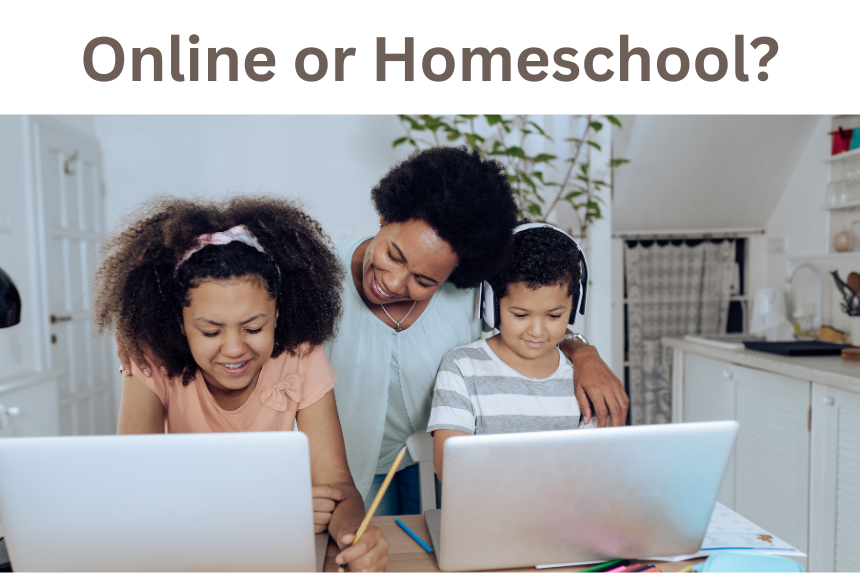
Online school is just homeschooling, right? Not quite. While both options let students learn from the safety of home with flexible schedules, online school and homeschooling are actually quite different, particularly when it comes to academic support and how much responsibility falls on the parent or guardian.
If you’re one of many U.S. parents exploring alternative school options for fall, how do you decide which is the best fit for your family? Let’s break down the key differences and clear up some common misconceptions about these fast-growing models.
Homeschool
Nearly 6% of U.S. students were homeschooled in summer and fall of 2022, according to the U.S. Census Bureau’s Household Pulse Survey. That number has steadily climbed over the past two decades, suggesting more families are recognizing the value of a personalized education at home.
If you’re considering homeschooling, here are some key factors to keep in mind:
Curriculum As the parent or guardian, you are responsible for purchasing a full curriculum or creating one—often by piecing together multiple resources. Each state requires a certain amount of instruction in core subjects like English, math, social studies, and science.
Schedule
Homeschool scheduling is flexible. You decide when the school day starts and ends and where breaks fall in between. However, some states have attendance requirements, including a minimum number of instructional hours and school days per year.
Academic Support
With homeschooling, you are the educator—planning lessons, teaching, monitoring progress, and offering feedback. But that doesn’t mean you have to do it alone. Tutors and homeschool co-ops can provide academic support throughout the school year, while online homeschool programs like K12 Homeschool can provide transcripts and progress reports.
Socialization
One misconception is that homeschool lacks socialization opportunities. The flexible schedule allows for plenty of time with friends through sports, the arts, field trips, co-ops, and camps. Your family gets to create a social environment that’s right for your child.
Legal Requirements
Each state has different homeschooling regulations. Most require you to file a notice of intent to homeschool with your local district or state. Then there’s standardized testing. Some require annual testing, others test at specific grade levels, and some don’t require it at all. Progress reports are also different. New York requires quarterly progress reports, while other states may only ask for one upon request.
Cost
Expenses will vary for each family, but you’ll need to budget for curriculum materials, courses, textbooks, and supplies, as well as enrichment activities like field trips, extracurriculars, and tutoring.
Online School
Online schools, whether public or private, allow students to learn from the safety of home while providing the academic structure of traditional schools. This model continues to grow in popularity as families seek the flexibility of homeschool with academic support built in.
Here are some key factors of online schools to consider:
Curriculum
Online schools provide a structured curriculum taught by state-certified teachers. Many incorporate innovative, hands-on learning opportunities with real-world applications. For example, K12-powered online schools provide an award-winning curriculum developed through over 20 years of research, with built-in flexibility to support a personalized education.
Schedule
Like homeschooling, online schools have a structure that can allow for more flexibility in the day and for self-pacing of lessons, but students in most cases will need to join scheduled virtual class sessions with their classmates led by their teacher.
Academic Support
A key difference between homeschool and online school is the kind of academic support provided. For example, classes at online schools supported by K12 are taught by state-certified teachers who track progress, provide feedback, and meet one-to-one with students. Parents can facilitate the daily schedule, but do not teach the curriculum.
Socialization
Online students have opportunities to interact with peers online and in-person. K12-powered online schools’ virtual campus, the K12 Zone, offers a safe place for students to play games and join clubs with their peers. Some online schools also organize local field trips, clubs, and other extracurricular activities so students can meet virtually or in person while engaging in activities that interest them.
Cost
Online schools can be tuition-free or fee-based, depending on options available in your area. Check whether materials like textbooks and supplies are included. For instance, West Virginia Virtual Academy provides course materials and sends them directly to your home.
While both homeschooling and online schools offer a flexible, personalized education from the safety of home, the key difference lies in academic support and responsibilities. Homeschooling gives parents full control of selecting the curriculum and teaching the material. Online school provides a curriculum taught by state-certified educators, while giving parents more room for a flexible daily schedule and an active role in their education.
Take some time to consider your availability, comfort with teaching, and what kind of support your child needs. The right choice depends on your family’s individual circumstances and what role you see fulfilling in their education.